



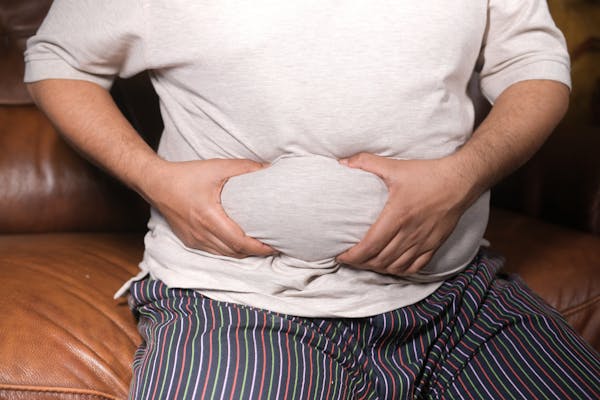
When the place you live in doesn’t feel like you… what does the body do?
We often think weight gain is about food.
Or movement.
Or hormones.
Or age.
But sometimes, the cause is not biological.
It is existential.
Sometimes, the cause… is the place.
When you live in a place that doesn’t reflect who you are,
a place where you don’t recognize yourself,
a place that offers neither inner peace nor a sense of belonging,
your body understands something very simple:
you are not home.
⸻
The body doesn’t philosophize. It adapts.
When the place doesn’t resonate with you,
your nervous system never truly settles.
It stays vigilant.
It stays in adaptation.
It stays in survival mode.
And living in survival mode is not living.
The body receives a constant, silent, deep message:
“The world is not safe.”
From that moment on, the body no longer tries to thrive.
It tries to protect.
It slows down.
It stores.
It thickens.
Not by mistake…
but by intelligence.
Weight is not a mistake. It is a strategy.
When the body doesn’t feel in its place,
it creates distance between you and the outside world.
It thickens its boundaries.
It reduces its sensitivity.
It builds a protective layer.
Weight becomes an invisible armor.
An armor against an environment perceived as unstable.
An armor against constant exposure.
An armor to soften the contact with life.
At this stage, weight is no longer a problem to fix.
It is a survival response.
And this changes everything.
It’s not the place… it’s the relationship
At a deeper level, this is never only about a place.
It is about relationship.
The relationship to the place.
The relationship to those who live there with you.
The relationship to the home.
The relationship to the partner.
The relationship to yourself.
For the body, there is no difference between:
a place… and a relationship.
Both ask the same fundamental question:
“Am I safe here?
Or do I need to protect myself?”
And when the answer is “I need to protect myself,”
the body takes over.
The invisible laws that govern the body
There are silent laws within human relationships.
Laws we don’t know intellectually,
but that the body follows perfectly.
These laws determine:
- whether we relax or become rigid,
- whether we open or close,
- whether we feel in our place… or too much.
When we are not in our place,
the body becomes a guardian.
It guards.
It protects.
It adds weight if necessary.
So sometimes, weight is not linked to what we eat,
but to the relational space we live in.
And to the place we occupy — or don’t dare to occupy.
Why this understanding is essential today
Because we have spent years trying to correct the effects:
the weight,
the symptoms,
the fatigue,
the anxiety.
Without returning to the origin:
the feeling of safety in our daily relationships.
As long as this foundation is missing,
the body will continue to defend itself.
What we are about to explore together
This is exactly what we open in the academy’s new course:
The Hidden Laws of Relationships
Where we reveal how invisible dynamics influence:
- the sense of safety,
- the nervous system,
- boundaries,
- the body,
- and even the outer appearance.
Because healing does not begin on the plate.
It begins when an inner truth settles back into place:
“I am in my place.
I am safe.
I belong.”
And only then,
the body can finally relax.
And gently lay down, one by one,
the armors it never wanted to wear.
